
Group leader: Beata Lontay PhD
Group members: Ilka Keller MD PhD
Adam Ungvari MSc
Petra Biró PhD student
Zoltán Nagyenyedi MD student
 |
 |
 |
 |
||||
Ilka Keller MD PhD Beata Lontay PhD
Potential therapy of fertility disorders in insulin-resistant women with smoothelin-like protein mimicking peptide 1
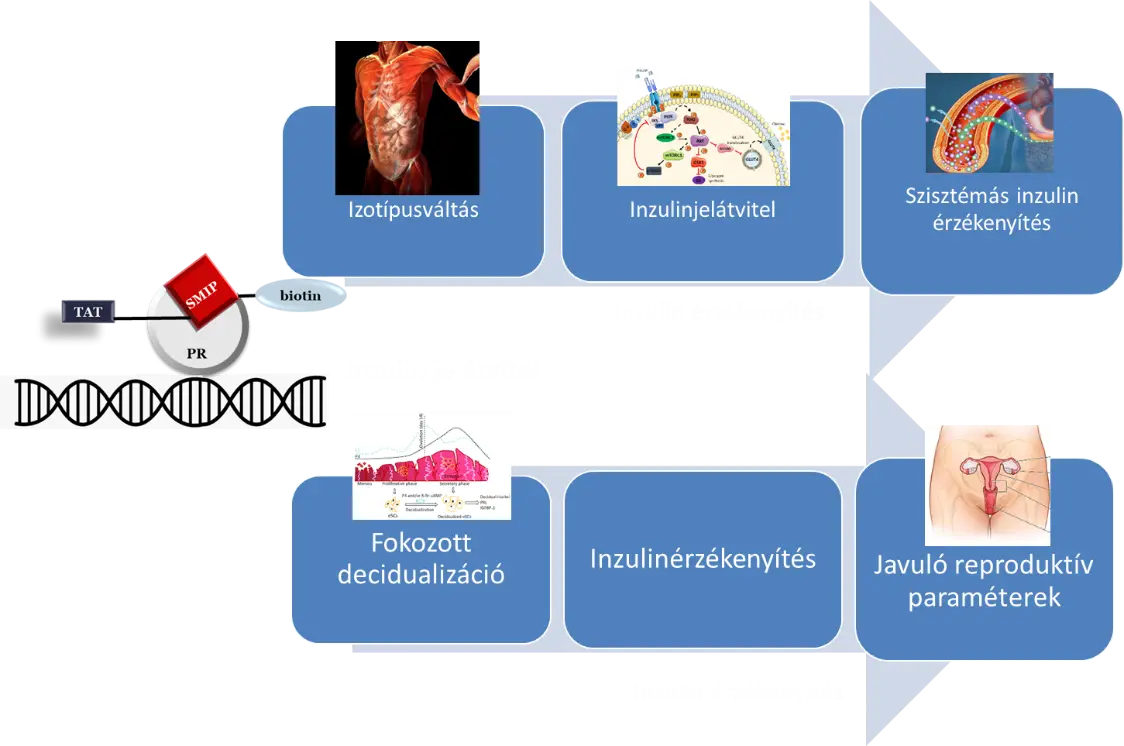
In collaboration with Richter Pharmaceutical Company, our research focuses on developing a novel peptide therapy to treat infertility in women suffering from insulin resistance and metabolic conditions like PCOS. By mimicking the natural SMTNL1 protein, this peptide restores insulin sensitivity in the uterus and skeletal muscle, effectively preparing the uterine environment for healthy embryo implantation without disrupting normal ovarian functions. Ultimately, it offers a targeted solution where current metabolic or fertility drugs fall short.
Reproductive disorders are significantly more prevalent in women with diseases related to impaired glucose homeostasis, such as insulin resistance. Elevated insulin and glucose levels are known to increase the risk of conditions like polycystic ovary syndrome (PCOS), endometriosis, and endometrial hyperplasia. Smoothelin-like protein 1 (SMTNL1), a protein expressed exclusively in steroid hormone-sensitive tissues and muscle, plays a critical role in these processes. SMTNL1 is cytosolically localized but translocates to the nucleus upon phosphorylation by protein kinase A, where it acts as a ligand-dependent transcriptional coregulator of progesterone receptor-B (PR-B). Studies in SMTNL1 null female mice revealed severe reproductive phenotypes, including reduced litter size, increased embryonic lethality, delayed fertilization, and concomitant insulin resistance.
This research focuses on developing and testing a membrane-permeable SMTNL1-mimic peptide (SMiP) that selectively inhibits PR-B to induce tissue-specific insulin sensitivity in skeletal muscle and endometrium. Using mammalian two-hybrid assays, reporter gene analyses, and proteomic profiling, the research team identified the shortest effective SMTNL1 peptide sequence that efficiently binds to PR and modulates gene expression relevant to insulin signaling and cytoskeletal organization.
 |
Grant: Nagyvállalati Fókuszterületi Innovációs Program (2024-1.1.3-NAGYVÁLL_FÓKUSZ)